Monday, May 2, 2011

Unity through Repetition

Repetition is using the same visual item over again which creates unity within the composition.

The element that repeats can be almost anything;


like the yellows in this Cezanne still life.


The shapes in this photograph.


and the texture in this photo.

Unity through Proximity

Proximity is the degree of closeness in the placement of elements,and this can help create unity. If items are placed far apart they can seem unrelated, but placing items close together groups them together and unifies the image.


In this Frida Kahlo still life, you can see that all of the objects are placed close together, which lumps them into one large group. If she had placed them farther apart, we may see them as separate types of fruit instead of one cluster of fruit.


Simply placing items close together gives them a relationship, even if they are unrelated.

Tactile and Visual Texture

Tactile texture is texture that can actually be felt, whereas visual texture is the impression of texture is purely visual and not physically felt.


In this still life painting, you can tell what the subject matter would feel like just by looking at the reproduction in this image. Although you cannot actually feel the smoothness of the cloth, you can tell it is. This is an example of visual texture. I obviously cannot give an example of tactile texture because you would not be able to feel the original image.

Rectilinear and Curvilinear Shapes

Rectilinear shapes are composed of straight lines, whereas curvilinear shapes consist of rounded and curving lines that imply that the shapes are flowing.


Most commonly, building and architecture features shapes that are rectilinear, they have sharp, rectangular edges.


we tend to think of rectilinear shapes as more nature oriented, with the flowing lines and shapes mimicked in nature.

Nonobjective shapes

When shapes do not reference an object or have no subject matter, they can be classified as nonobjective. When a work does not have a story or subject matter, it must be appreciated as purely an aesthetic design.


Abstraction

Works where the artist has obviously detracted details from the original subject in order to reproduce it can be called works of abstraction.


Abstraction is a very common form of distortion. And the degree of abstraction can vary, as you can see from the first image to the second.


This artist has reduced many of the details down to just basic geometric shapes. Notice that the image is almost immediately recognizable as a woman. This form of abstraction can sometimes be called "reductive."

Idealism

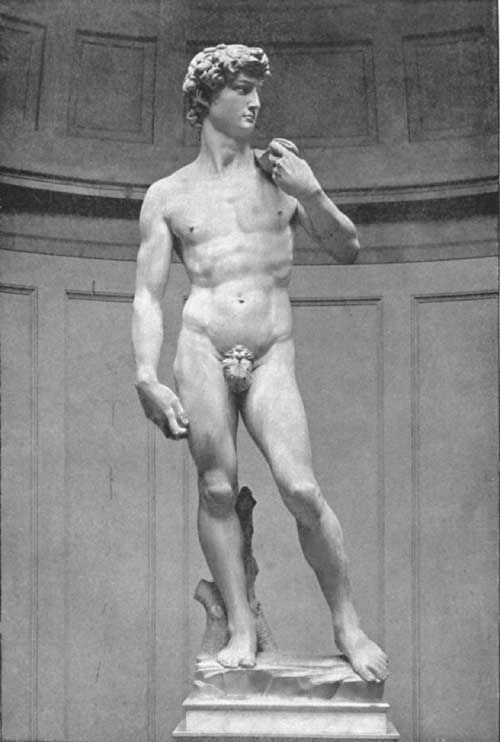
A specific type of artist distortion is idealism. Idealism is when an artist creates an image not how it is in nature, but how it would be ideally.


Michelangelo's David is considered to be the ideal proportions of the human body. But it is not something that nature could produce, the artist has improved on nature and therefore it is an idealism sculpture.