Tactile texture is texture that can actually be felt, whereas visual texture is the impression of texture is purely visual and not physically felt.
In this still life painting, you can tell what the subject matter would feel like just by looking at the reproduction in this image. Although you cannot actually feel the smoothness of the cloth, you can tell it is. This is an example of visual texture. I obviously cannot give an example of tactile texture because you would not be able to feel the original image.
Monday, May 2, 2011
Rectilinear and Curvilinear Shapes
Rectilinear shapes are composed of straight lines, whereas curvilinear shapes consist of rounded and curving lines that imply that the shapes are flowing.
Most commonly, building and architecture features shapes that are rectilinear, they have sharp, rectangular edges.
we tend to think of rectilinear shapes as more nature oriented, with the flowing lines and shapes mimicked in nature.
Most commonly, building and architecture features shapes that are rectilinear, they have sharp, rectangular edges.
we tend to think of rectilinear shapes as more nature oriented, with the flowing lines and shapes mimicked in nature.
Nonobjective shapes
When shapes do not reference an object or have no subject matter, they can be classified as nonobjective. When a work does not have a story or subject matter, it must be appreciated as purely an aesthetic design.
Abstraction
Works where the artist has obviously detracted details from the original subject in order to reproduce it can be called works of abstraction.
Abstraction is a very common form of distortion. And the degree of abstraction can vary, as you can see from the first image to the second.
This artist has reduced many of the details down to just basic geometric shapes. Notice that the image is almost immediately recognizable as a woman. This form of abstraction can sometimes be called "reductive."
Idealism
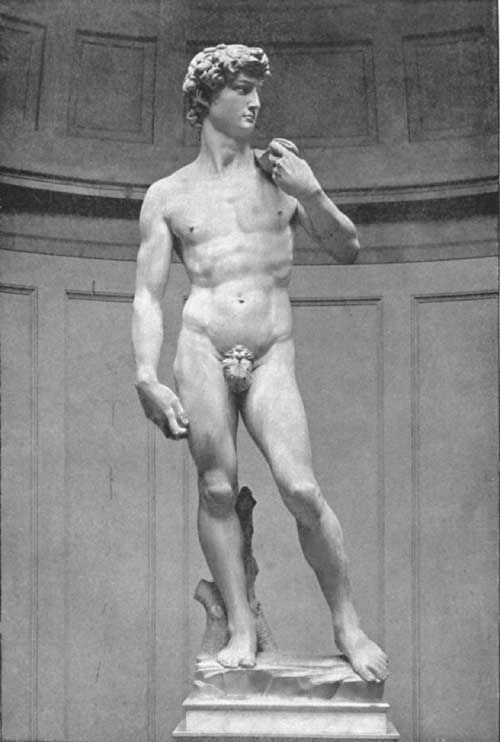
A specific type of artist distortion is idealism. Idealism is when an artist creates an image not how it is in nature, but how it would be ideally.
Michelangelo's David is considered to be the ideal proportions of the human body. But it is not something that nature could produce, the artist has improved on nature and therefore it is an idealism sculpture.
Naturalism and Distortion
When an artist reproduces an image as it is seen in nature, it is known as naturalism, but has also been called realism. Distortion, on the other hand, is the opposite. The artist will purposefully exaggerate and manipulate the proportions to create a distorted image.
As you see in this first image, the Mona Lisa, her proportions are believable and realistic. She looks like she would in nature. This is a naturalistic portrait.
As seen in this second image, inspired by the first, her proportions are way off and she does not look as she would in nature. This is an example of distortion.
Lost and Found Contour
When only some contours are visible in a work, it's called a lost and found contour.
In this Caravaggio painting, "David with the Head of Goliath" he has used this technique. You can see that parts of David's body isn't seen because it is in the darkness. This does not mean that his shoulder is missing. It is just implied.
This is very useful in creating emphasis, as you can see in this other Caravaggio piece.
Subscribe to:
Posts (Atom)